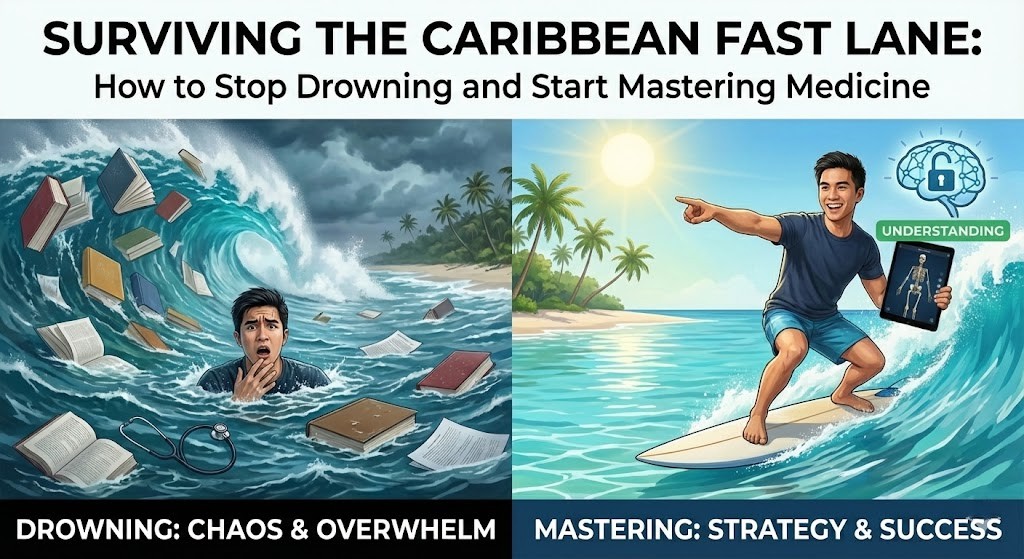

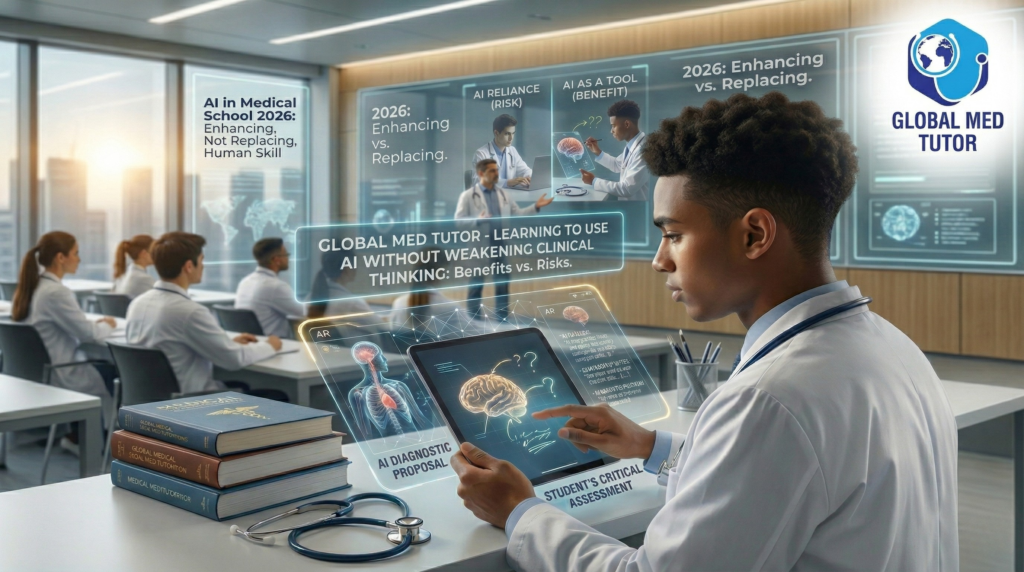
Med school is a lot. Lectures that never end, textbooks the size of bricks, and question banks that somehow keep multiplying. Then AI walks in, and suddenly it feels like you have been handed a cheat code. One prompt. Fifty pages, condensed. Type in symptoms, get a differential. Ask for a management plan, done in thirty seconds.
It honestly feels like a superpower.
But here’s the thing, most students don’t clock until it’s too late: AI can make you feel competent much faster than you actually become competent.
That smooth feeling is hiding something. At first, everything looks great. You are covering more content, your notes are clean, and concepts seem to click faster than they ever did before. But then exam day comes. You read the vignette. You think, I have seen this. You go to build the answer and… it doesn’t come together the way you expected.
You saw it. You even understood it when AI explained it. You just never really worked through it yourself. That’s the gap. And it shows up at the worst possible moment.
Why this actually happens
Your brain is efficient, maybe too efficient. When AI handles the heavy lifting, remembering details, connecting ideas, and structuring your reasoning, those mental muscles quietly stop getting trained. You are not building anything, you are borrowing it.
The research backs this up. The “Google Effect” found that when we expect information to be available externally, we don’t encode it as deeply internally. Bjork’s work on learning keeps returning to the same uncomfortable truth: effort matters. Struggle matters. If studying always feels easy, it usually isn’t sticking.
To be fair, AI is genuinely useful
It saves time. It explains confusing topics without judgment. It gives you practice questions at 2 am when no one else is awake. Most students are already using it, and honestly, it does help. But efficiency isn’t the same as mastery. That’s the part that gets glossed over.
The actual trap
It’s subtle. You paste a question in, get a clean answer back, read it once, feel satisfied, and move on. No struggle. No real attempt to build the answer yourself. No friction.
And friction, annoyingly, is where learning lives.
When you need that answer later without the AI open next to you, it’s not as solid as it felt when you first read it. That’s not a technology problem. That’s a learning problem.
So how do you use it without letting it use you?
Don’t stop using AI. That’s not realistic, and it’s not the point. Just change the order.
Try the question first. Even if your answer is messy or half-wrong, try. Then use AI to check what you missed, where your reasoning drifted, what you didn’t even think to consider. Then close everything, and try again from memory.
That last step, the one that feels slightly annoying and unnecessary, is actually where the learning sticks.
And some things just aren’t meant to be outsourced. Clinical reasoning. Communication. The judgment call at the bedside. Those aren’t skills you download. They’re built through repetition, reflection, and a lot of being wrong before you’re right.
One last thing
Every time you slow down and actually think before reaching for the prompt bar, you’re building something real. Something that shows up when it matters, in the exam hall, on the ward, in the room where someone needs you to actually know what you’re doing.
Use AI. It’s a powerful tool. Just don’t let it quietly do your thinking for you.
References
- Sparrow, B., Liu, J., & Wegner, D. M. (2011). Google Effects on Memory. Science.
- Bjork, E. L., & Bjork, R. A. (2011). Making Things Hard on Yourself, But in a Good Way: Creating Desirable Difficulties.
- Masters, K. (2024). AI in medical education. Medical Teacher.
- Chen, M. et al. (2025). Generative AI and learning outcomes. BMC Medical Education.